


Blog

Pensions done better

calendar icon 23 November 2026
time icon 5 min

Author

Darren Baillie
Opens in new window

Darren Baillie

Partner

The pensions landscape is changing. In 2015, the introduction of pension freedoms granted members autonomy in deciding how to turn their lifetime of savings into an annual pension.

However, for many, the gift of flexibility and choice is a burden of responsibility they’re uncomfortable taking on. Most members are ill-equipped to make independent and informed decisions about their retirement, and paying for advice to address the gaps in their knowledge can be unappealing.

Members need something more. And the pension industry’s response to that challenge has included:

  • The launch of the first single-employer collective pensions (CP) scheme, also known as collective defined contribution (CDC). The first multi-employer schemes are now on the journey to authorisation in 2027, with retirement CP also on the horizon.

  • The FCA’s Advice Guidance Boundary Review, which aims to make targeted support and simplified advice available to millions of consumers and pension scheme members.

  • The Pensions Dashboards Programme, which will give people greater visibility and control over their pensions.

  • Plans for the consolidation of small pots and automatic transfer of poor value legacy contract-based pension arrangements.

  • Department for Work and Pensions (DWP) Guided Retirement, plans to require defined contribution schemes to provide a default decumulation solution to members.

Amidst this change, demand for product innovation remains, and it seems inevitable that how individuals can choose to build and transform a lifetime of savings into a retirement income will change in the coming years.

One size won’t fit all. While the government hopes CP will take off, and momentum is certainly building, other approaches are also emerging. These include hybrid products such as later-life annuitisation, guided drawdown and longevity pooling, alongside more traditional approaches such as drawdown and annuity purchase

For trustees, deciding which save and spend solution is best for their members will be a minefield of complexity that’s challenging to navigate. But it’s vital they are well-equipped to meet that challenge.

Unfortunately, there’s no perfect pensions solution that’ll suit all members all the time, so assessing trade-offs is key:

  • Higher expected pensions may come with less predictable income streams.

  • Collective solutions may mean sacrificing some flexibility.

  • Increased complexity may lead to lower understanding and member engagement.

There’s no such thing as a free lunch, and trustees will have different views on what’s most important for their members. Arriving at an answer is about assessing those trade-offs in the context of overarching objectives, rather than finding a solution that performs best in every possible respect.

Defining what good looks like

We’ve found that the following characteristics are key considerations in assessing the suitability of different retirement solutions.

  • Income sustainability: provide an income that can be reliably maintained throughout a member’s retirement.

  • Income protection: avoid large reductions in income.

  • Inflation-proofing: insulate pension income from rising prices.

  • Income stability: provide an income that doesn’t change from year to year.

  • Investment flexibility: allow investment strategy to be tailored.

  • Income flexibility: the capacity to draw more or less income in some years.

  • Bequest provision: the capacity to pass on a legacy to loved ones.

  • Resilience: navigate significant economic/market events.

  • Member engagement: provide protection against poor decision-making.

Expressing those features in an intuitive, understandable and measurable way means we can work with clients to draw out what matters most to them.

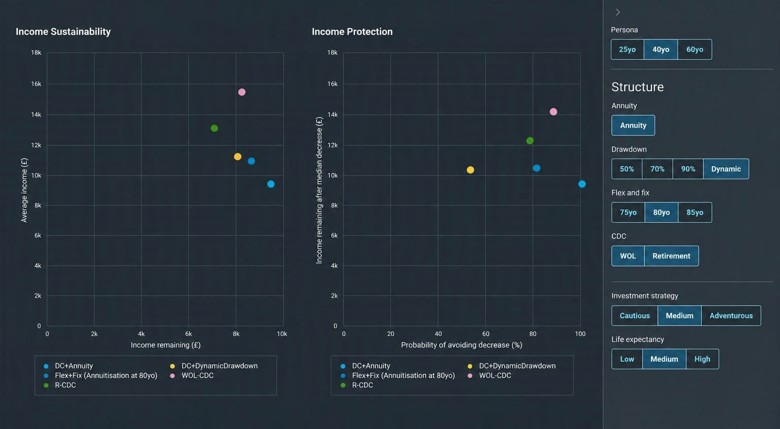
We use our CDC AIR™ modelling framework to analyse different aspects of different solutions across different members, helping our clients reach confident, well-informed decisions.

CP Air

CDC AIR™ compares member outcomes across different retirement solutions. Click here to view a larger image.

The left-hand chart shows expected retirement income over 30yrs vs. retirement income in a poor outcome; the right-hand chart shows the income remaining after a typical annual pension decrease vs. the chance of a pension decrease occurring.

The charts shown are illustrative and intended to demonstrate how different metrics, assumptions and comparator products can influence the assessment of member outcomes; they’re not intended to represent forecasts of future outcomes or quantify the benefits of a particular design.

Please get in touch if you’d like to learn more about how to:

  • Determine what’s most important for you and your members.

  • Understand what leads to successful outcomes for your members.

  • Inform decisions around new retirement products.

  • Design your optimal retirement proposition.

  • Compare different forms of DC risk sharing in retirement product designs.

This blog is based upon our understanding of events as at the date of publication. It is a general summary of topical matters and should not be regarded as financial advice. It should not be considered a substitute for professional advice on specific circumstances and objectives. Where this blog refers to legal matters please note that Hymans Robertson LLP is not qualified to provide legal opinion and therefore you may wish to obtain independent legal advice to consider any relevant law and/or regulation. Please read our Terms of Use - Hymans Robertson.

Sign up for our mailing list

We pride ourselves on being thought leaders and are constantly discussing the many issues facing and shaping our industry. Sign up to find our current thinking on topical issues.

Opens in new window Subscribe
  • Latest industry news

  • First access to upcoming events

  • Content tailored to your interests

  • Access to exclusive content

Opens in new window Subscribe