Welcome to the penultimate blog in this series on Design Thinking.
So far we’ve looked at 1) empathising with users, 2) defining the problem we’re looking to solve, before moving on to 3) generating ideas, nattily known as ideation. These activities have broadly taken an exploratory – or, in design-speak, a “divergent” approach. If we considered these stages fully, we started simply with a desire to serve our clients and end users better. And now we have a huge array of options in front of us.
We need to take this mountain of ideas (some of which will prove to be more valuable than others) and start to commit them to reality. Clearly, you can’t do everything. Up to this point, we've gathered and developed as many potential solutions as possible. We now want to “converge” on the solutions that might work.
Before we invest fully in rolling out a solution, there’s a powerful, often underused step that we can use to save time, money and frustration – and that step is (drum-roll)... Prototyping.
In the world of public services and pensions, where decisions can feel very “high-stake” and risk-aversion is common - prototyping might seem like a risk in itself due to its experimental nature. But the reality is that it’s one of the safest (and possibly smartest) things you can do to reduce risk.
What is a prototype?
A prototype is a low-cost, simplified version of your idea, created to gather feedback before committing to a full solution. It’s not about building a polished final product, or even what’s referred to as an MVP (minimum viable product - nothing viable yet required!). This is all about making an idea tangible enough that people can react to it, use it, and tell you what works and what doesn’t. Think of it as "just real enough" to learn from.
In practice, that might be in the form of:
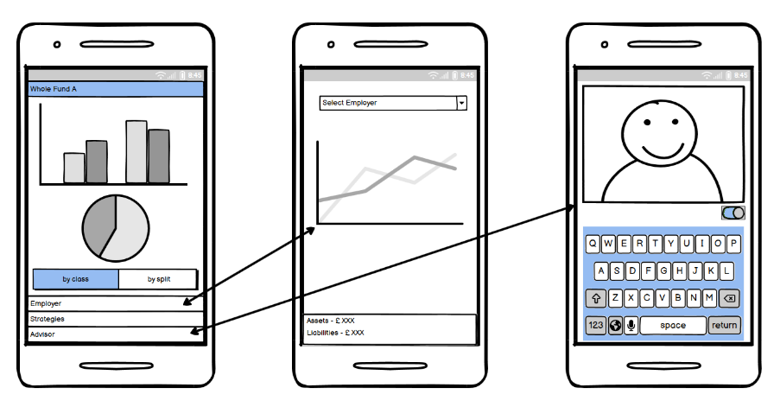
A new online member dashboard, mocked-up in PowerPoint.
A process diagram for staff to walk through and critique - sketched out on paper.
Even a draft phone script of a new onboarding process.
Why prototyping matters in the LGPS
We work within a complex system that is rightly risk averse in many respects. But that caution can sometimes lead to fully implementing a detailed solution in an attempt to cover off all the possible ‘edge cases’. This can take time, budget and political capital – and you may discover too late that it doesn't quite land.
Prototyping is a more valid way to reduce that risk than more traditional user research, such as focus groups and surveys. By bringing users into the process earlier, you’re not just asking “Do you like this?”- you’re actively testing:
Does this make sense to members?
Can staff follow the new process without extra training?
Is this solving the problem we actually set out to address in the first place?
It doesn’t need to be all singing, all dancing
Creating a prototype should not be expensive and ideally is quick and cheap to create (such that if it doesn’t work, you’re not going to be too upset if you have to throw it away!).
Prototypes aren’t about polish. In fact, the rougher it is, the more feedback you’re likely to get - because people feel more comfortable suggesting changes to something that isn’t “finished”.
“Lo-Fi” sketched and sketch-like prototypes and wireframes (as above) work better than “Hi-Fi” mock-ups.
The goal here is learning, not perfection. One of the biggest mindset shifts that prototyping encourages is reframing “failure.” If a prototype doesn’t work as expected that’s actually a win! But why? Because you’ve learned something crucial before it became expensive (or embarrassingly public). That learning is what helps you adjust, refine, or even pivot entirely.
In my final blog in this series, I’ll talk through the Test phase - where you take those prototypes you’ve built and put them into the real world. We’ll look at how to gather meaningful insights, and decide what to refine, scale or rethink, closing the loop of the Design Thinking process.
If you have any questions on anything covered in this blog, please get in touch.
Important information
This blog is based upon our understanding of events as at the date of publication. It is a general summary of topical matters and should not be regarded as financial advice. It should not be considered a substitute for professional advice on specific circumstances and objectives. Where this blog refers to legal matters please note that Hymans Robertson LLP is not qualified to provide legal opinion and therefore you may wish to obtain independent legal advice to consider any relevant law and/or regulation. Please read our Terms of Use - Hymans Robertson.
Sign up for our newsletter
We pride ourselves on being thought leaders and are constantly discussing the many issues facing and shaping our industry. Sign up to find our current thinking on topical issues.